Slots On Sign Posts in Chile
Chile (CL)

Small rectangle slots on top of sign or shevrons posts before traffic sign
108 metas (location clues) in Latin America - How to Identify: tag names, country, example imagery, and a short explanation for each.

@Mrs. Plongeur463 plays108 metas
Exam Score

 Slots On Sign Posts in Chile
 Ladder PolesBrazilian Chevrons
 Striped Signposts in Peru
 Green Stone Kilometer Markers in Uruguay
 Mexican White BollardsTriangular Concrete Bollard
 Ecuadorian Bollards+2Road Signs Without a White Border
 Plate with a Black DotBlue Water TanksWooden Signposts in UruguayRoad Signs - Highway Stickers on the Back
 Thick Wooden Signposts in BoliviaBolivian Black-and-White Kilometer MarkersGuardrail Markings in Bolivia
 Colombian Road Sign CrossKilometer Markers in EcuadorOrange Commercial Vehicle PlatesDouble Concrete PolesArgentine Hazard SignWooden A-frame polesBlack-and-Yellow Utility Poles in PeruChilean Concrete Utility PolesChilean hazard signCross-Shaped Sign Supports in ParaguayParaguayan Flag on a Utility PoleYellow Plates on Commercial Vehicles in Peru and UruguayChilean Domain: .clArgentina’s Domain - .arPortuguese vs. SpanishPeru’s Domain: .pe+11Spanish vs. PortugueseParaguayan Kilometer Markers
 +1“Una Vía” and “Doble Vía” SignsArgentine Kilometer MarkersTeal Blue Sign BacksReddish Sidewalk TilesBlack Stickers on Peruvian Concrete PolesUruguayan White Stone BollardsDouble Guardrails in EcuadorColombian Kilometer MarkerMexican Route SignsWhite Plates on Commercial Vehicles in ColombiaEcuadorian Yellow TaxisSquare Road Signs
 Red and Green Utility Poles in GuatemalaMexican Kilometer MarkersBlack-and-Yellow Guardrails in PeruPeruvian Concrete Kilometer MarkersLarge Concrete Pole ElementsBlack-and-Yellow Striped Poles in ColombiaColombian Pale-Yellow Taxis with White Plates
 Bluish License Plates in Costa Rica
 Panama’s License Plates with a Green StripeBright Yellow Stickers on Mexican Wooden PolesNo Front License Plates in Puerto RicoTaxi Door Plate MarkingUruguayan Triple Road LinesPanamanian Wooden FencesUruguayan Trident Poles+1White License Plates with a Blue StripYellow and Red Guardrail ReflectorsPanamanian Stop Signs+2ALTO vs. PAREBolivian Cobblestone RoadsCurved Wooden Utility Poles+8PARE Stop SignsRed Taxis in Costa RicaPeruvian Metal Electricity MetersBlack Sign BacksArgentine ChevronsImperial Beer AdsRoad Sign with an Eye SymbolWooden Fences with Pointed TopsSquare Cross-Shaped Sign Supports in Costa RicaBrazilian Phone NumbersEcuadorian “Ladder” PolesEcuador’s Low-Quality “Shitcam”Colombian Private License PlatesThick Arrows on Mexican Road SignsConcrete Blocks at the Base of Signposts in PeruBrazilian Kilometer MarkersUruguay’s Domain: .uyBlack-and-White Hazards in MexicoOctagonal Concrete Utility Poles in MexicoBrazil’s Domain: .brTransparent Satellite DishesUnique Gen 3 Car in ChileGen 3 Black Car With Antenna
 Gen 3 Red Pickup US Virgin IslandsGen 3 White Pickups US Virgin IslandsEcuador - White Gen 4 PickupBlurred Pickup Truck (Paraguay)+3White Gen 4 CarBlack Car Gen 4+2Gen 4 White-Blue-White CarGen 4 Grey Car+2Smallcam
 Dominican Republic’s White Car Gen 3Guatemala’s Gray Street View Car+1Gen 3 White Car With AntennaGen 2 Coverage in Latin AmericaCosta Rica’s White Pickup+2Blue Car Gen4+1White Car in Gen 3+1Black Car in Gen 3
 Curaçao’s Black Car Gen 3
How it looks
Where to find it
ChileExplanation
Small rectangle slots on top of sign or shevrons posts before traffic sign
Chile (CL)
Small rectangle slots on top of sign or shevrons posts before traffic sign
Brazil (BR), Paraguay (PY)

The notched pole, often referred to as a “ladder pole”, is very common in Brazil and Paraguay.
Brazil (BR)

Brazilian chevrons feature a yellow arrow on a black background, a combination unique among Brazil’s neighboring countries.
Note: Yellow-background chevrons can also be found in Brazil, but they are much less common.
Important: black background
Peru (PE)

Peru uses distinctive road signs with black-and-white striped posts. In some areas, you may also encounter signs with black-and-yellow stripes.
Uruguay (UY)

This green-painted stone kilometer marker is unique to Uruguay.
Note: Other colors can occasionally be found, but green is by far the most common.
Mexico (MX)

White cylinder with rounded or flat top. Bottom is painted black.
Note: Main reflector/s is usually white. Sometimes is yellow.
Peru (PE)

The triangular concrete bollard is unique to Peru. Common variants include:
Ecuador (EC)

In Ecuador, there are two main types of bollards:
Bollards along roads are very common in Ecuador. Besides these two main types, you may also encounter other designs that follow a similar style and color scheme.
Note: Similar rectangular bollards can occasionally be found in Malaysia.
Chile (CL), Paraguay (PY), Colombia (CO), Brazil (BR)

Road signs without a white border around the edge are typically found only in three countries: Chile, Colombia, Paraguay and Brazil.
Note: In Brazil, these signs are usually larger in size.
Argentina (AR)

A unique white Argentine license plate with a black dot in the center.
Important: black dot
Note: This is old license plate, most commonly seen in Gen 3 coverage.
Brazil (BR)
Memory hook: Blue tank, white text: just like the globe on Brazil's flag

Look for blue water tanks in Brazil.
Location: They are often on special water towers or building roofs.
Shape: These tanks have a distinctive short and wide form with white words are usually printed on them
Important: You can often see the word FORTLEV printed on them.
Note: Water tanks are common in many countries around the world, so focus on their distinctive features when using them as a clue.
Uruguay (UY)

In Uruguay, thick wooden signposts are a common sight and are typically painted white. The back of the post often features up to four rectangular notches, making them a useful clue for identifying the country.
Note: Similar thick wooden signposts can also be found in Bolivia.
Chile (CL)

Sometimes you can find a black-and-white circle with this highway shield on the back of road signs. It can also be a white sticker. With current Street View cameras, it is impossible to read the information on them, but their presence is helpful.
This print/sticker is unique to Chile.
Bolivia (BO)

In Bolivia, thick wooden signposts are commonly found. They may be painted in different colors or left as natural wood.
Note: Uruguay also has thick wooden signposts, but they are always white and often feature several rectangular openings on the back.
Bolivia (BO)

Bolivia’s kilometer markers are black and white. The top section features the abbreviation “Km”, while the bottom section indicates the kilometer number. Road numbers are not shown on these markers.
Note: From a distance, they can look similar to Argentine kilometer markers. The key difference is that Argentine markers display the road number.
Bolivia (BO)

Some guardrails feature black-and-yellow markings, with the yellow stripes always on the outer edges.
Note: Similar markings can be found in Peru, but the pattern is reversed - black stripes are always on the outer edges.
Colombia (CO)

In Colombia, road signs almost always have a cross-shaped support on the back.
Important: The back of the sign and the cross-shaped support are white.
Note: Cross-shaped sign supports can also be found in Costa Rica and Paraguay, but they are not white as in Colombia.
Ecuador (EC)

Ecuador has a wide variety of kilometer markers along its roads. However, the most common type is a green rectangular marker. Some also display the road number.
Chile (CL), Ecuador (EC)
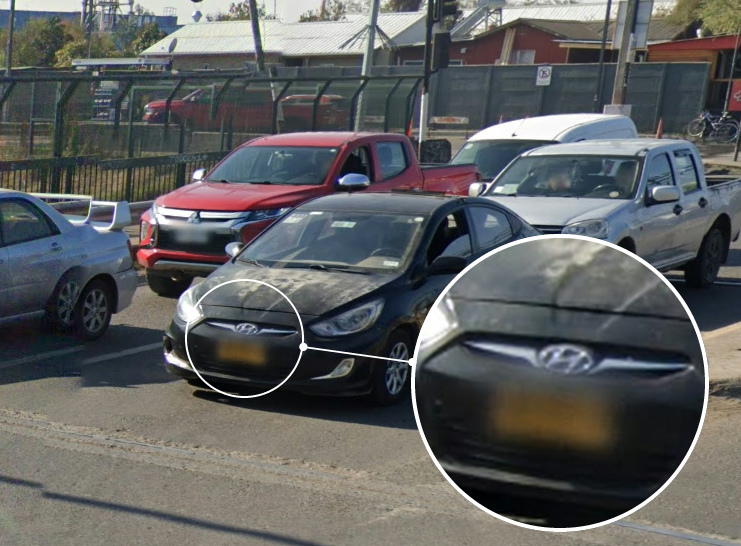
Orange plates on commercial vehicles are found only in Chile and Ecuador among all Latin American countries.
Note: In Ecuador, these plates are being phased out and replaced with white plates featuring an orange stripe at the top
Argentina (AR)
Memory hook: Argentina - A-Shaped Utility Pole (letter A)

Double concrete poles, also known as A-shaped poles, are almost unique to Argentina.
Note: rarely seen in Bolivia
Argentina (AR)

The Argentine hazard sign features a red-and-white design and a low, rectangular shape, distinguishing it from the similar Chilean version, which is noticeably narrower and more elongated.
Shape: Vertical rectangle. Usually with rounded border and thick
Color: Red-and-white diagonal stripes
Argentina (AR)
Memory hook: Argentina - A-Shaped Utility Pole (letter A)

A double wooden or A-frame wooden utility pole is found only in Argentina among Latin American countries.
Peru (PE)

In Peru, some utility poles have their lower sections painted black and yellow. Unlike similar poles in Colombia, the paint in Peru extends all the way down to the ground.Important: Pole Painting Extending to the ground
Chile (CL)

Chilean concrete utility poles are often square or rectangular. They feature vertical slots on both sides.
Note: Look for small circular holes near the top of the pole.
Chile (CL)

The Chilean hazard sign features a distinctive red-and-white design with an elongated shape. Its shape is the key feature that sets it apart from the similar Argentine version.
Important: elongated shape
Note: A similar long white-and-red hazard marker can sometimes also be found in Paraguay.
Paraguay (PY)

In Paraguay, the back of road signs often features cross-shaped supports.
Note: The back is usually gray, not white as in Colombia. Unlike Costa Rica, the signpost and cross-shaped support are typically round rather than square.
Paraguay (PY)

Color: White bottom paint sometimes with Paraguay flag
Peru (PE), Uruguay (UY)

Commercial vehicles in Peru and Uruguay have yellow license plates. This includes buses, trucks, cars, and other types of commercial transport.
Note:
Chile (CL)

The country-code domain for Chile is .cl.
Argentina (AR)

The country-code domain for Argentina is .ar
Brazil (BR)

Portuguese and Spanish can look very similar, but these features can help tell them apart:
These differences are especially useful when identifying the language from short signs or other text.
Brazil is the only country in Latin America where Portuguese is the official language.
Peru (PE)

Peru’s country-code domain is .pe
Argentina (AR), Chile (CL), Colombia (CO), Ecuador (EC), Peru (PE), Mexico (MX), Panama (PA), Costa Rica (CR), Puerto Rico (PR), Bolivia (BO), Uruguay (UY), Paraguay (PY), Guatemala (GT)

Spanish is the dominant language across Latin America and is spoken in all major countries except Brazil, where Portuguese is the official language.
Portuguese and Spanish can look very similar, but these features can help tell them apart:
Paraguay (PY)

Paraguay’s kilometer markers feature the Paraguayan flag, making them a useful clue for identifying the country.
Ecuador (EC), Puerto Rico (PR), Dominican Republic (DO)

Signs reading “Una Vía”, “Doble Vía” and other phrases can only be found in Ecuador, Puerto Rico, and the Dominican Republic among Latin American countries.
Argentina (AR)

Argentina’s kilometer markers are typically black and white and usually display the road number along with the kilometer number. Road numbers on kilometer markers:
RN — National highways, shown in white on the map
RP — Provincial roads, shown in green on the map
Ecuador (EC)

Sometimes, the backs of road signs are painted teal blue. The signs are mounted on thin metal poles.
Important: Ecuador is the only country in Latin America where turquoise-colored sign backs are used.
Colombia (CO)

Sidewalks in Colombia are often paved with reddish-colored tiles, making them a useful clue for identifying the country.
Peru (PE)

Round concrete utility poles are widespread throughout Peru. Many feature stickers and distinctive markings that can help identify the correct region. Black stickers are among the most recognizable clues.
Uruguay (UY)

In Uruguay, stone bollards painted white are commonly found. They come in various shapes, and in some cases, one side is painted yellow.
Note: unlike the bollards found in Peru, Uruguayan bollards are generally rectangular in cross-section.
Ecuador (EC)

In Ecuador, double guardrails are much more common than in other Latin American countries.
Colombia (CO)

Colombia uses two types of kilometer markers: a tall green marker with the letters “Pr” at the top, and a traditional stone marker with black lettering. Both types are unique to Colombia.
Note: The first two digits at the bottom indicate the road number.
Mexico (MX)

Mexico has two main types of route signs:
Colombia (CO)

Commercial vehicles in Colombia have white license plates, unlike private vehicles, which have yellow plates. This includes taxis, buses, trucks, and other commercial vehicles.
Ecuador (EC)

Ecuadorian taxis are bright yellow and have orange license plates. The name of the city or town can sometimes be seen on the side doors.
Important: orange license plates
Ecuador (EC), Paraguay (PY)

Ecuador widely uses square road signs with a white background. Similar signs can also be found in Paraguay.
Note: Sign designs may vary by region.
Guatemala (GT)

In Guatemala, utility poles painted red, green, or a combination of both are very common.
Note: Similar pole coloring can occasionally be found in other countries, such as Bolivia.
Mexico (MX)

Mexico’s kilometer markers are elongated rectangular signs with black characters on a white background. They may also display the road number.
Peru (PE)

Black-and-yellow stripes on guardrails are a distinctive feature of Peru.
Note: Similar striped guardrails can also be found in Bolivia. The key difference is that Peru uses black outer stripes, while Bolivia uses yellow outer stripes.
Peru (PE)

Peruvian kilometer markers are made of concrete and are usually painted black and white. However, colored variants can also be found occasionally. Some markers also display the road number.
Peru (PE), Argentina (AR)

These large concrete blocks on utility poles can be found in Argentina and Peru.
Note: Similar large horizontal concrete elements are also commonly found in Turkey.
Colombia (CO)

In Colombia, utility poles are often painted with black-and-yellow stripes. One key detail to look for is that the striped section does not extend all the way to the ground.
Important: The paint does not reach the ground.
Note: Similar poles can be found in Peru, but there the black-and-yellow paint reaches the ground.
Colombia (CO)

Colombian taxis are always pale yellow in color. Unlike private vehicles, they have white license plates, which are often displayed on the sides and roof of the car. When the plates are not blurred, the city name is often visible (a similar side sticker is also found on buses).
Important: сolombian taxis are pale yellow, and their license plates are white.
Note: Ecuadorian taxis can look similar, but they use a slightly brighter yellow and typically have orange license plates.
Costa Rica (CR)

In Costa Rica, private vehicle license plates are white with blue symbols. When blurred, they often appear bluish, making them a unique clue among Latin American countries.
Note: Similar bluish-looking license plates can also be found in Guatemala.
Panama (PA)

Panama uses white license plates with a green stripe at the top, a combination that is unique to the country.
Mexico (MX)

Some wooden utility poles in Mexico feature a bright yellow sticker.
Puerto Rico (PR)

In Puerto Rico, front license plates are not required.
Important: Among all Latin American countries, this is unique to Puerto Rico.
Panama (PA)

Taxis in Panama are typically bright yellow and feature a checkerboard pattern along the sides.
On the side of taxis in Panama, you can find a depiction of the license plate featuring the city name and a regional code.
Note: Taxi plates in Panama are the same as those used on private vehicles - white with a green stripe.
Uruguay (UY)

Triple road lines are common in Uruguay, consisting of two solid yellow lines with a white dashed line between them. This road marking pattern is unique in the Americas.
Panama (PA)

Fences along most roads in Panama are partially or entirely made from small tree trunks and branches. The remaining fence posts are also almost always wooden.
Note: Similar fences can be found in other countries, but they are much more common in Panama.
Uruguay (UY)

Uruguay has several types of utility poles. One of the most common and useful is the “trident” pole, named for its distinctive top with three upward-facing insulators.
Note: Similar trident poles can also be found in the neighboring Brazilian state of Rio Grande do Sul.
Brazil (BR), Argentina (AR), Paraguay (PY)

White license plates with a distinctive blue strip at the top follow the Mercosur standard. This format is used in several South American countries, including Argentina, Brazil, Paraguay and Uruguay.
Note: Uruguay is covered exclusively by Gen 3 imagery from 2015 in Google Street View. Therefore, you will not see license plates with the blue strip in Uruguay.
Argentina (AR), Uruguay (UY)

Yellow and red reflectors can be found on guardrails in both Argentina and Uruguay.
Note: Guardrails in these countries may sometimes have no reflectors at all. However, if you spot yellow or red reflectors, the location is usually either Argentina or Uruguay.
Panama (PA)

In Panama, stop signs use the Spanish word ALTO in a bold font. The bold lettering helps distinguish Panamanian signs from similar ALTO signs found in Mexico, Costa Rica, and Guatemala.
Note: Thin lettering can also occasionally be found in Panama.
Mexico (MX), Costa Rica (CR), Panama (PA), Guatemala (GT)

In Panama, Costa Rica, Mexico, and Guatemala, stop signs use the word ALTO. In most of the rest of Latin America, PARE is used instead.
Note: In Panama, ALTO is often written in bold lettering.
Bolivia (BO)

Cobblestone roads are common in Bolivia. They often feature a distinctive pattern, with several neat rows of stones separating more irregular sections of cobblestones.
Bolivia (BO)

Many wooden utility poles in Bolivia have a noticeably curved shape, often resembling natural tree trunks. This is especially common in the eastern part of the country.
Note: Slightly curved poles can also be found in other countries, but strongly curved poles are a very good clue for Bolivia.
Argentina (AR), Brazil (BR), Chile (CL), Peru (PE), Uruguay (UY), Paraguay (PY), Ecuador (EC), Colombia (CO), Dominican Republic (DO), Puerto Rico (PR)

PARE is used on stop signs in Argentina, Bolivia, Brazil, Chile, Colombia, Ecuador, Paraguay, Peru, Uruguay, as well as in the Dominican Republic, and Puerto Rico.
Costa Rica (CR)

Taxis in Costa Rica are typically red.
Note: In Panama, they are yellow.
Peru (PE)

Peruvian electricity meters have a distinctive appearance: they are rectangular, metal, and usually feature two or three horizontal slots. They are commonly found in residential areas across the country.
Important: 2 or 3 horizontal slots.
Brazil (BR), Paraguay (PY)

Black backs of road signs are common in Brazil and can occasionally be found in Paraguay.
Note: There are various types of poles and mounting systems. What matters is that the back of the sign is this dark, almost black color.
Argentina (AR)
Memory hook: 🇦🇷 Argentina = Red Arrow

Argentine chevrons feature a red arrow on a white background. This combination is unique in both North and South America.
Costa Rica (CR)

Advertisements for Imperial beer featuring its black eagle mascot are commonly seen throughout Costa Rica.
Panama (PA)

Red octagonal signs with an unusually realistic eye are a unique feature of Panama.
This unique sign installed by local community groups in partnership with the Police. The "eye" symbolizes that residents are watching for crimes.
Colombia (CO)

In Colombia, wooden fences with pointed tops are commonly found, and these tips are often painted.
Note: Use this clue with caution, as similar fences can also be found in other Latin American countries, although they are less common there.
Costa Rica (CR)

In Costa Rica, cross-shaped sign supports are commonly found. Unlike similar supports in other countries, both the signpost and the cross are typically square-shaped.
Important: The signpost and supports are square-shaped, most commonly found on diamond-shaped signs.
Brazil (BR)

Phone numbers are commonly visible in Brazil and follow the format XX-XXXXXXXXX. The first two digits are the regional area code. The code may appear in parentheses or sometimes be omitted entirely.
Important: Knowing these two-digit area codes can be useful for identifying the correct region of Brazil.
Ecuador (EC)

Ecuadorian “ladder” poles have numerous small indentations that resemble the steps of a ladder. In Latin America, these poles are mainly found in Ecuador.
Most utility poles in Ecuador are round and made of concrete. These poles are fairly standard and are not particularly useful for identifying the country.
Note: Brazilian waffle poles also have indentations, but usually only a few, unlike the numerous indentations found on Ecuadorian ladder poles.
Ecuador (EC)

The low-quality camera known as the official Ari, or “Shitcam,” can only be found in Ecuador among Latin American countries. The car may appear fully blurred or partially visible.
Colombia (CO)
Memory hook: 🇨🇴 Colombia = COLOR → yellow! 🟨

Colombian private license plates are short with yellow background.
Mexico (MX)

In Mexico, arrows on road signs are noticeably thicker than those used in other countries.
Peru (PE)

Peru has a distinctive sign mounting style where concrete blocks are used at the base of the signposts.
Important: Concrete "legs" of signs
Brazil (BR)

Brazilian kilometer markers are rectangular and blue. The abbreviation BR indicates federal highways, while regional road numbers include the abbreviation of the respective Brazilian state.
Uruguay (UY)

Uruguay’s Domain: .uy
Mexico (MX)

In Mexico, you can find distinctive black-and-white hazards. They come in different shapes and styles, but this color combination is unique to Mexico.
Mexico (MX)

Most utility poles in Mexico are made of concrete and have an octagonal shape. Their sides often feature engraved markings.
Note: Similar faceted concrete poles are also common in Colombia.
Brazil (BR)

Brazil’s country-code domain is .br.
Brazil (BR)

Transparent satellite dishes are most commonly found in Brazil.
Chile (CL)

In Chile, Gen 3 coverage features a unique white car with a visible black section.
Note: most Gen 3 coverage has been replaced, but this camera may still occasionally appear.
Colombia (CO)

In Colombia (Gen 3 coverage) only, you can find a black car with an antenna. The car's color isn't always clearly visible due to the blur, but if you can see a black trunk through the blur on both sides of the antenna, it is a reliable indicator for Colombia.
Note: Due to heavy blurring, determining the car's color can sometimes be difficult.
United States Virgin Islands (VI)

This Red pickup only found on main (south) island of US Virgin Islands.
United States Virgin Islands (VI)

There are actually 2 types of white Virgin Islands car:
Ecuador (EC)

Part of the Gen 4 coverage in Ecuador was captured using a white pickup with a large red brake light and no antenna. These features help distinguish it from the pickups found in Panama and Costa Rica.
Note: The pickup may be fully or partially blurred.
Paraguay (PY)

A blurred pickup truck with the front part of the roof visible and no antenna.
Note: It can be black or gray, and may sometimes have brown bird droppings visible on it.
Brazil (BR), Argentina (AR), Chile (CL), Colombia (CO), Mexico (MX)

White car in Gen 4 can be found in Brazil, Colombia, Chile, Argentina, and rarely in Mexico.
Important: You must be able to see the hood, not the trunk!
Note: The hood may be visible but blurred.
Peru (PE), Mexico (MX)

Black cars in Gen 4 are found only in Peru and Mexico.
Notes:
Argentina (AR), Brazil (BR), Chile (CL), Mexico (MX)

A white car with a blue center, creating a distinctive white-blue-white appearance, can be found in Brazil, Argentina, Chile, and Mexico.
Note: The hood may be visible but blurred.
Colombia (CO), Peru (PE)

A gray car in Gen 4 can be found in Peru and Colombia.
Notes:
Peru (PE), Puerto Rico (PR), Brazil (BR), Argentina (AR)

Smallcam is found only in Peru, Brazil, Argentina and Puerto Rico in Latin America. This camera is mounted lower than a standard Gen 4 camera and features a relatively large, round blur with a small protrusion at the front.
Dominican Republic (DO)

The Dominican Republic has a unique car featuring a white vehicle with a roof rack.
Important: The visible parts of the roof rack have thick black stripes.
Guatemala (GT)

This gray Street View car with a visible roof rack can be found throughout Guatemala.
Note: The only other tropical country with a similar car is Laos. The car used in the Dominican Republic may look similar, but it has thick black stripes on the roof rack bars.
Ecuador (EC), Mexico (MX), Brazil (BR)

In Latin America, a Gen 3 white car with an antenna is found only in Colombia, Ecuador, Mexico and Brazil. While the vehicle's color isn't always clearly visible due to the blur, seeing a white trunk through the blur is a reliable indicator that you are in one of these four countries.
Mexico (MX)

Gen 2 coverage in Latin America almost always points to Mexico, where most of it has already been replaced by newer generations.
Important: Gen 2 coverage is characterized by heavy blurring at the top and bottom of the image and a very low-quality camera.
Note: Gen 2 can also be found in Brazil, but only a handful of panoramas remain.
Costa Rica (CR)

The Gen 4 coverage in Costa Rica was captured using a large white pickup. In many locations, it can be seen either fully or partially, although it may sometimes be completely blurred. An antenna is mounted at the front of the vehicle. Sometimes, black electrical tape can be seen on the truck bed.
Notes:
Argentina (AR), Mexico (MX), Chile (CL), Brazil (BR)

A blue car can only be found in Brazil, Argentina, Chile, and Mexico in Latin America.
Important: You must be able to see the hood, not the trunk!
Note: The hood may be visible but blurred.
Peru (PE), Chile (CL), Bolivia (BO)

The white car in Gen 3 coverage is found only in Chile, Peru, and Bolivia. It may appear either blurred or unblurred.
Note: Most Gen 3 coverage in Peru and Chile has since been replaced with newer imagery, but it can still occasionally be found in some locations.
Argentina (AR), Uruguay (UY), Peru (PE)

The black car in Gen 3 coverage is found only in Argentina, Uruguay, and Peru. The hood may appear either blurred or unblurred.
Note: Most Gen 3 coverage in Argentina and Peru has since been replaced with newer imagery.
Curaçao (CW)

In Curaçao, a unique car can be recognized by a black vehicle with a roof rack. The visible parts of the rack also feature white stickers.
Note: Cars with roof racks can also be found in Puerto Rico, Guatemala, and the Dominican Republic. However, the black car with stickers on the rack is unique to Curaçao among Latin American countries.
Latin America - How to Identify covers 108 metas in Chile, Brazil, Paraguay, Peru, Uruguay, Mexico. Every one of them shows up in practice until you can place it from memory.


%20--%3e%3csvg%20version='1.1'%20id='Layer_1'%20xmlns='http://www.w3.org/2000/svg'%20xmlns:xlink='http://www.w3.org/1999/xlink'%20x='0px'%20y='0px'%20width='16px'%20height='16px'%20viewBox='0%200%2016%2016'%20style='enable-background:new%200%200%2016%2016;'%20xml:space='preserve'%3e%3cstyle%20type='text/css'%3e%20.st0{fill:%2357AEFF;}%20.st1{fill:%237A6BFF;}%20.st2{fill:%23AB5CFF;}%20.st3{fill:%23FF7DC0;}%20.st4{fill:%23FFBE57;}%20.st5{fill:%2373E61C;}%20.st6{fill:%23FF6242;}%20.st7{fill:%23F2F2F2;}%20.st8{fill:%23696969;}%20.st9{fill:%23FF3029;}%20.st10{fill:%23131F24;}%20.st11{fill:%23F1F7FB;}%20.st12{fill:%23EE5555;}%20.st13{fill:%2349C0F8;}%20.st14{fill:%233F85A7;}%20.st15{fill:%231CB0F6;}%20.st16{fill:%2393D333;}%20.st17{fill:%2379B933;}%20.st18{fill:%23FFAB33;}%20.st19{fill:%23FFC700;}%20.st20{fill:%23D84848;}%20.st21{fill:%23FB7185;}%20.st22{fill:%23DCE6EC;}%20.st23{fill:%2352656D;}%20.st24{fill:%2337464F;}%20.st25{opacity:0.5216;fill:%23FF3029;}%20.st26{opacity:0.5216;fill:%23F2F2F2;}%20.st27{clip-path:url(%23SVGID_2_);fill:%23F2F2F2;}%20.st28{clip-path:url(%23SVGID_4_);fill:%23F2F2F2;}%20.st29{clip-path:url(%23SVGID_6_);fill:%23F2F2F2;}%20.st30{clip-path:url(%23SVGID_8_);fill:%23F2F2F2;}%20.st31{clip-path:url(%23SVGID_10_);fill:%23F1F7FB;}%20.st32{clip-path:url(%23SVGID_12_);fill:%23F1F7FB;}%20.st33{fill:none;stroke:%2393D333;stroke-width:0.3;stroke-miterlimit:10;}%20%3c/style%3e%3cpath%20class='st13'%20d='M16,0.55v14.9c0,0.31-0.41,0.56-0.91,0.56H0.92C0.41,16,0,15.75,0,15.44V0.55C0,0.25,0.41,0,0.92,0h14.16%20C15.59,0,16,0.25,16,0.55z'/%3e%3cpath%20class='st11'%20d='M5.83,15.25V1.17c0-0.37,0.3-0.67,0.67-0.67h3.66c0.37,0,0.67,0.3,0.67,0.67v14.08c0,0.37-0.3,0.67-0.67,0.67%20H6.5C6.13,15.92,5.83,15.62,5.83,15.25z'/%3e%3cpath%20class='st12'%20d='M6.89,5.32V2.35c0-0.43,0.35-0.78,0.78-0.78h1.13c0.43,0,0.78,0.35,0.78,0.78v2.97c0,0.43-0.35,0.78-0.78,0.78%20H7.68C7.24,6.1,6.89,5.75,6.89,5.32z'/%3e%3cpath%20class='st17'%20d='M16,14.49v0.96c0,0.31-0.41,0.56-0.91,0.56H0.92C0.41,16,0,15.75,0,15.44v-0.96H16z'/%3e%3c/svg%3e)


 12
12


%20--%3e%3csvg%20version='1.1'%20id='Layer_1'%20xmlns='http://www.w3.org/2000/svg'%20xmlns:xlink='http://www.w3.org/1999/xlink'%20x='0px'%20y='0px'%20width='24px'%20height='24px'%20viewBox='0%200%2024%2024'%20style='enable-background:new%200%200%2024%2024;'%20xml:space='preserve'%3e%3cstyle%20type='text/css'%3e%20.st0{fill:%2357AEFF;}%20.st1{fill:%237A6BFF;}%20.st2{fill:%23AB5CFF;}%20.st3{fill:%23FF7DC0;}%20.st4{fill:%23FFBE57;}%20.st5{fill:%2373E61C;}%20.st6{fill:%23FF6242;}%20.st7{fill:%23F2F2F2;}%20.st8{fill:%23696969;}%20.st9{fill:%23FF3029;}%20.st10{fill:%23131F24;}%20.st11{fill:%23F1F7FB;}%20.st12{fill:%23EE5555;}%20.st13{fill:%2349C0F8;}%20.st14{fill:%233F85A7;}%20.st15{fill:%231CB0F6;}%20.st16{fill:%2393D333;}%20.st17{fill:%2379B933;}%20.st18{fill:%23FFAB33;}%20.st19{fill:%23FFC700;}%20.st20{fill:%23D84848;}%20.st21{fill:%23FB7185;}%20.st22{fill:%23DCE6EC;}%20.st23{fill:%2352656D;}%20.st24{fill:%2337464F;}%20.st25{opacity:0.5216;fill:%23FF3029;}%20.st26{opacity:0.5216;fill:%23F2F2F2;}%20.st27{clip-path:url(%23SVGID_2_);fill:%23F2F2F2;}%20.st28{clip-path:url(%23SVGID_4_);fill:%23F2F2F2;}%20.st29{clip-path:url(%23SVGID_6_);fill:%23F2F2F2;}%20.st30{clip-path:url(%23SVGID_8_);fill:%23F2F2F2;}%20.st31{clip-path:url(%23SVGID_10_);fill:%23F1F7FB;}%20.st32{clip-path:url(%23SVGID_12_);fill:%23F1F7FB;}%20.st33{clip-path:url(%23SVGID_14_);fill:%23F1F7FB;}%20.st34{clip-path:url(%23SVGID_16_);fill:%23F1F7FB;}%20.st35{clip-path:url(%23SVGID_18_);fill:%23F1F7FB;}%20.st36{clip-path:url(%23SVGID_20_);fill:%23F1F7FB;}%20.st37{clip-path:url(%23SVGID_22_);fill:%23F1F7FB;}%20.st38{clip-path:url(%23SVGID_24_);fill:%23F1F7FB;}%20.st39{clip-path:url(%23SVGID_26_);fill:%23F1F7FB;}%20.st40{clip-path:url(%23SVGID_28_);fill:%23F1F7FB;}%20.st41{clip-path:url(%23SVGID_30_);fill:%23F1F7FB;}%20.st42{clip-path:url(%23SVGID_32_);fill:%23F1F7FB;}%20.st43{clip-path:url(%23SVGID_34_);fill:%23F1F7FB;}%20.st44{clip-path:url(%23SVGID_36_);fill:%23F1F7FB;}%20.st45{clip-path:url(%23SVGID_38_);fill:%23F1F7FB;}%20.st46{clip-path:url(%23SVGID_40_);fill:%23F1F7FB;}%20.st47{fill:none;stroke:%2393D333;stroke-width:0.3;stroke-miterlimit:10;}%20.st48{fill:%23486E20;}%20%3c/style%3e%3cg%3e%3cpath%20class='st7'%20d='M14.97,22.63V6.07c0-0.69,0.56-1.25,1.25-1.25h0.88c0.69,0,1.25,0.56,1.25,1.25v16.57%20c0,0.69-0.56,1.25-1.25,1.25h-0.88C15.53,23.88,14.97,23.33,14.97,22.63z'/%3e%3cpath%20class='st7'%20d='M16.41,0.26l-3.77,6.54c-0.11,0.19,0.03,0.42,0.24,0.42h7.55c0.22,0,0.35-0.24,0.24-0.42L16.9,0.26%20C16.79,0.07,16.52,0.07,16.41,0.26z'/%3e%3c/g%3e%3cg%3e%3cpath%20class='st7'%20d='M9.27,1.43V17.9c0,0.69-0.56,1.25-1.25,1.25H7.16c-0.69,0-1.25-0.56-1.25-1.25V1.43%20c0-0.69,0.56-1.25,1.25-1.25h0.86C8.71,0.18,9.27,0.74,9.27,1.43z'/%3e%3cpath%20class='st7'%20d='M7.83,23.68l3.75-6.5c0.11-0.19-0.03-0.42-0.24-0.42h-7.5c-0.22,0-0.35,0.24-0.24,0.42l3.75,6.5%20C7.45,23.87,7.72,23.87,7.83,23.68z'/%3e%3c/g%3e%3c/svg%3e)
 Browse all theory →