Korean


South Kore
Unique
Script: Hangul
Name: Korean (Hangugeo (한국어), Hangukmal (한국말))
Style: Use of circles in many letters, which sets it apart from most other East Asian scripts
Examples:
- 아
- ㅇㅋ
- ㅜㅜ / ㅠㅠ
- 앙, 잉, 웅, 엥, 옹
- 아, 이, 우, 에, 오
GeoGuessr theory · Region
Clues that help you narrow down east asia in GeoGuessr — from signage and road surfaces to regional plant life and architecture.
Last updated ·


Script: Hangul
Name: Korean (Hangugeo (한국어), Hangukmal (한국말))
Style: Use of circles in many letters, which sets it apart from most other East Asian scripts
Examples:

Concrete utility poles are wrapped in
that extend all the way to the ground
Tap a highlighted country to preview it.

Public signs in Japan use a mix of
The differences are:
Katakana used for:

A yellow-and-black diagonal reflective sleeve wrapped around a utility pole, attached with metal or plastic bands/wires.
It is installed partway up the pole, does not reach the ground, and may be partially open or fully cylindrical.

Utility poles in South Korea almost always have
Usually
But in Taiwan, the stripes extend all the way to the ground.
Also, Korea’s stripes are a brighter yellow, whereas Taiwan’s have more of an orange color.
Tap a highlighted country to preview it.

Type: Private
Shape: Short
Background: Green or white
Text: White or green

White metal guardrails - usually Type-A

In Taiwan, metallic poles are wrapped in
that don't extend all the way to the ground
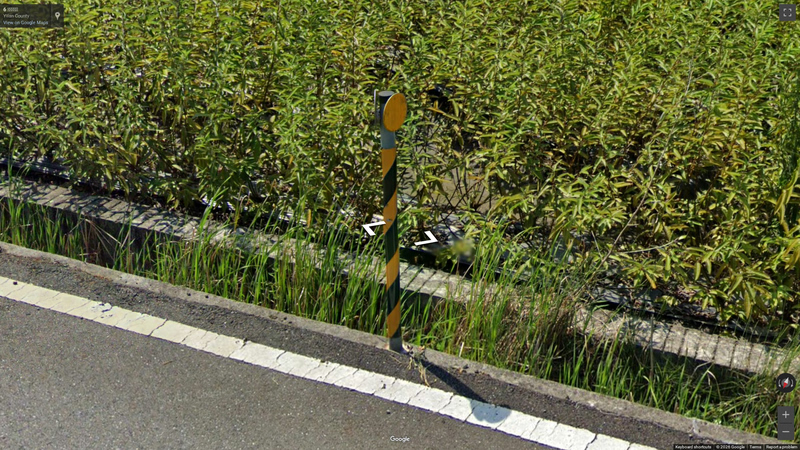
Often black-yellow diagonal stripes from bottom to almost top
Attached circle reflector. Yellow on the front side, and red on the back.
VS Japan:
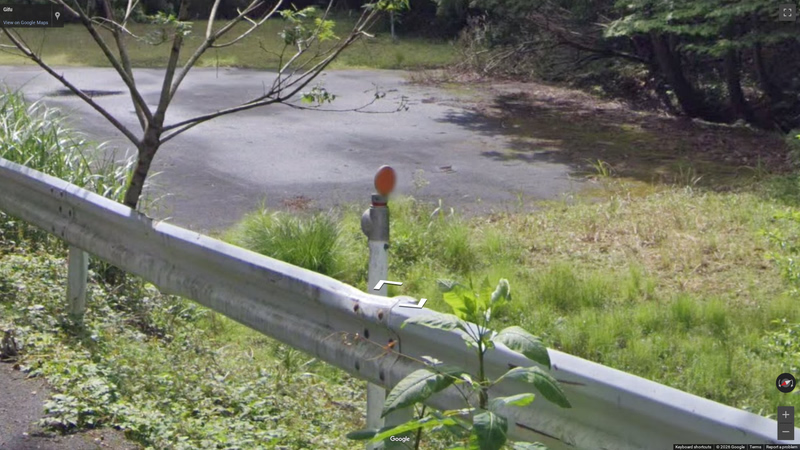
Cylinder metal with one or two orange round reflectors on top on the front side and white on the back side. Reflectors placed inside grey metallic frame
May include extra attachments (snow poles on the top)

On rural and mountain roads, you’ll often see concrete retaining walls with interlocking block patterns

In urban areas, dark green or grey box-shaped transformers are often mounted on short plinths. Even plinths without transformers can be a useful feature to notice.

A yellow-and-black vertical reflective sleeve wrapped around a utility pole, attached with metal or plastic bands/wires.
It is installed partway up the pole, does not reach the ground, and may be partially open or fully cylindrical.

Most poles are topped with

Continuous red edge lines mark no-parking zones and are a feature almost unique to Taiwan’s city streets.
Sometimes the no-parking zones are marked with red-painted curbs instead

Material: Plastic card
Shape: Rectangle
Color: Background - Blue, green, white-orange. Text - white
Text: The line with 1 letter and 4 numbers (F0453) represent coordinates to this particular location. Letter mark a grid block. Numbers give a location within that grid block (east–west and south–north percentages). The second line (if present) can provide greater precision (like within ~10 m) or additional grid refinement.

A blue pentagon showing two children crossing is used to mark school zones and pedestrian crossings
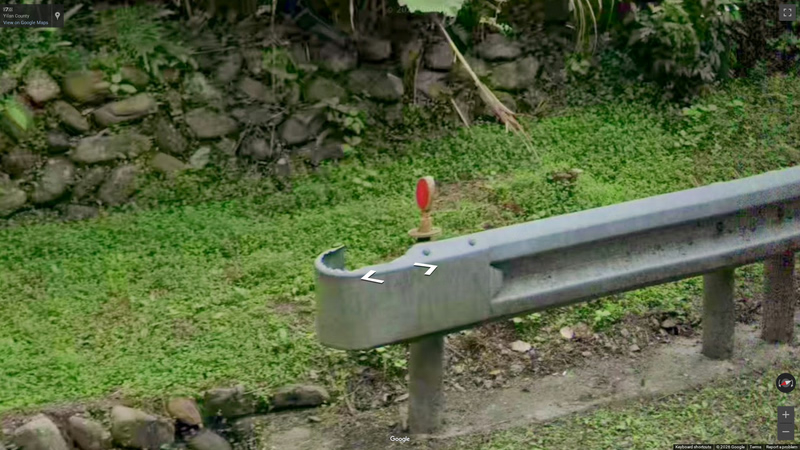
Attached circle. Yellow on the front side, red on the back side
Japan small reflectors placed on the white post vs yellow/no color in Taiwan

Japan’s stop sign is a red upside-down triangle with the kanji ‘止まれ’ (tomare)

Bollards are wedge-shaped, coloured white, with a circle yellow reflector on the front and grey circle on the back

A grey-and-white
reflective sleeve wrapped around a utility pole, attached with metal or plastic bands/wires.
It is installed partway up the pole, does not reach the ground, and may be partially open or fully cylindrical.

A green-and-white diagonal reflective sleeve wrapped around a utility pole, attached with metal or plastic bands/wires.
It is installed partway up the pole, does not reach the ground, and may be partially open or fully cylindrical.

Quality: Low resolution. Mainly used between 2008–2011.
Colors: Muted, slightly washed out.
Blur: A strictly circular (round) blur visible beneath the car when looking down. This is the most reliable identifier.
Quick ID: Low quality + perfectly circular blur under the car = Generation 2.

Driving direction: Left Side

Type: Commercial, Kei cars (small cars)
Shape: Short
Background: Yellow
Text: Black

Convex mirrors at junctions and bends always have a bright orange frame, often with writing on them

In Taiwan, the writing on signs is in Traditional Chinese, a script known for its highly detailed characters made up of many strokes.
Japanese, while it also includes Chinese characters (kanji), looks different because it mixes in two additional writing systems: hiragana and katakana. These have simpler shapes and make Japanese text easier to tell apart from pure Traditional Chinese

Roadside utility poles are round concrete columns with spiral grooves.
They often have:

Bright orange-rimmed convex mirrors are placed at junctions and blind bends

Highway roads have different markings than city roads.
The outer lines are usually yellow on one side and white on the other, while the center lines are typically white

Many roads have open concrete channels running alongside them to drain rainwater. Similar channels can also be seen in Japan

Type: Commercial
Shape: Long or short
Background: Yellow
Text: Black

On most city and suburban roads, the center is marked with double solid yellow lines and the edges with single white lines.
On narrower lanes, the double yellow is sometimes replaced with a dashed yellow

In Japan, Street View images are taken by a black or white Google car.
Sometimes you’ll see it in black, and occasionally it may even have an antenna.
Tap a highlighted country to preview it.
Drill this on a map quiz that covers this country.